
Received a letter from Opos? They’re a Scottish debt collection agency based in Dumbarton — not bailiffs. They can’t enter your home or take your belongings.
And if you’re in Scotland, the rules on how long they can chase you are very different to England — and in your favour.
Last reviewed: 28 June 2026
Quick Answers #
| Question | Answer |
|---|---|
| Can Opos force entry to your home? | No — they’re debt collectors, not bailiffs or Sheriff Officers |
| Are they legitimate? | Yes — FCA authorised (FRN 693817), Companies House active company, CSA member no. 685 |
| Can you ignore them? | Not recommended — but check the age of the debt first |
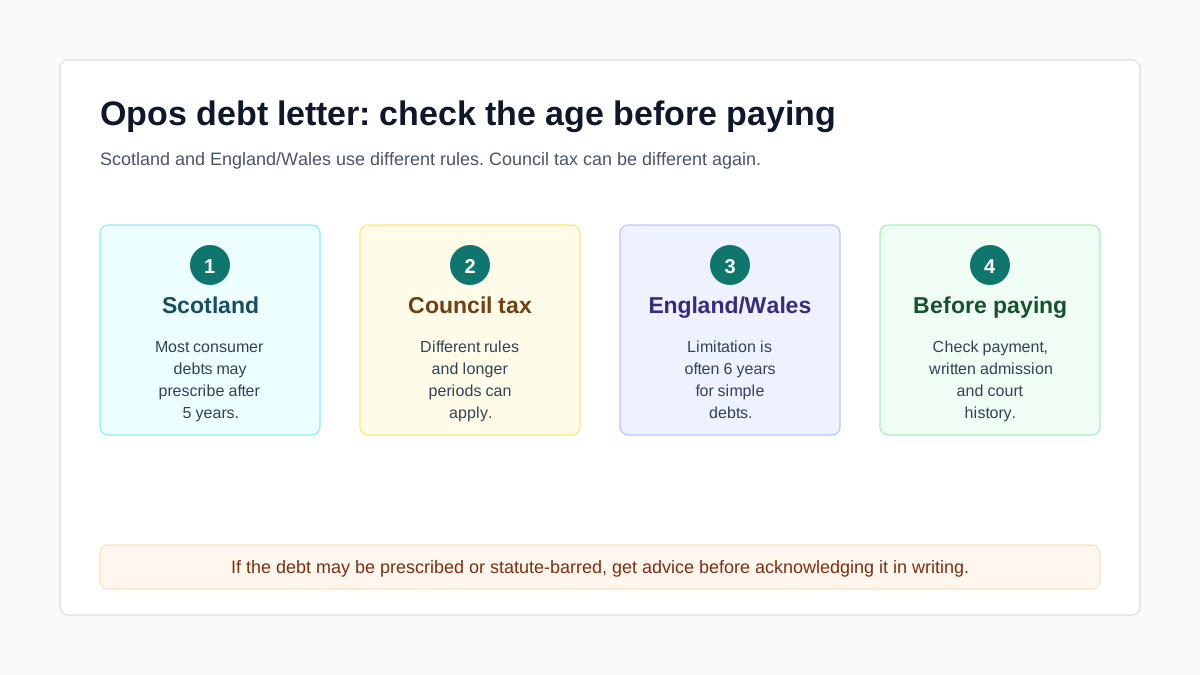
| Is your debt statute-barred? | 5 years in Scotland (debt is DESTROYED), 6 years in England/Wales |
| Can an IVA stop them? | Yes — or a Trust Deed if you’re in Scotland |
What You’ll Find on This Page #
- Who are Opos?
- Why is Opos contacting you?
- Can Opos send bailiffs or force entry?
- Is your Opos debt statute-barred? Scotland vs England
- Vague Opos letters
- What to do if Opos contacts you
- How to stop Opos — if you live in Scotland
- How to stop Opos — if you live in England or Wales
- Council tax debt and Opos
- Settlement offers from Opos
- Who owns Opos?
- How to complain
- Opos verification checks
- Contact Opos
- FAQs
Who are Opos? #
Opos is a debt collection agency based in Dumbarton, West Dunbartonshire, Scotland. A letter may relate to an energy, telecoms, catalogue, bank, council-tax or purchased-debt account.
Key facts:
- Company number: SC338837 (incorporated March 2008)
- FCA authorised: FRN 693817
- CSA member: No. 685, according to the CSA member directory
- Owned by: Scott Craig Dawson (sole PSC with 75%+ shares since inception)
- Holding company: Opos Group Ltd (SC613558, created November 2018)
- Letter types: may include collection for another creditor or an account assigned to Opos
- Public records to check: Companies House, FCA Register and CSA directory
They may operate in two different ways: collecting for a creditor who still owns the account, or pursuing a debt that has been assigned to them. Your letter should say which creditor or account is involved. If it does not, ask for written proof before discussing payment.
Why is Opos Contacting You? #
Opos contacts you for one of two reasons:
1. They bought your debt
Some lenders and service providers assign old accounts to debt purchasers. If Opos owns the account, your letter should make the assignment or creditor position clear.
Once purchased, Opos owns the debt and can decide the recovery strategy.
2. They’re collecting on commission
Some creditors may instruct Opos to collect while the creditor still owns the account. In this case, the creditor name and reference should still be visible on the letter.
Common account types that may appear on debt-collector letters:
- Energy bills
- Telecoms accounts
- Store or catalogue accounts
- Credit cards
- Council tax
- Personal loans
- Catalogue debt
Vague letter warning #
If you get a vague letter from Opos asking you to call and “verify your identity”, do not assume the balance is correct.
The letter may not clearly say what the debt is for.
Before you discuss payment, ask for:
- the original creditor
- the account reference
- the balance breakdown
- whether Opos owns the debt or is collecting for someone else
- evidence of the last payment or written acknowledgement if the debt is old
See the vague letter checks below before sharing extra personal details.
Can Opos Send Bailiffs or Force Entry? #
No. Absolutely not.
Opos is a debt collection agency, not a bailiff firm or Sheriff Officer practice. They have no enforcement powers.
If they send someone to your door, that person is a private citizen. They have no more legal authority than a door-to-door salesman.
What Opos field agents CAN’T do:
- Force entry to your home
- Enter without your permission
- Seize your belongings
- Clamp your car
- Threaten you with asset seizure
- Stay on your property if you ask them to leave
- Speak to your neighbours about your debt
What you CAN do:
- Refuse to open the door
- Ask them to leave (they must comply immediately)
- Request post or email and explain any vulnerability or accessibility need; necessary and proportionate contact may continue
- Report them to the FCA if they overstep
Opos vs Bailiffs vs Sheriff Officers — The Difference #
The enforcement system is different in Scotland and England.
Opos (Debt Collection Agency):
- Debt collection agency
- No right to enter your home
- Can’t seize belongings
- Must leave if asked
- Regulated by FCA
- Can only negotiate payment
Bailiffs (England/Wales):
- Enforcement agent with court powers
- Can enter in specific circumstances (with warrant)
- Can seize and sell assets
- Don’t have to leave (if they have valid warrant)
- Regulated by Ministry of Justice
- Can enforce court judgments
Sheriff Officers (Scotland):
- Officer of the court with statutory powers
- Can enter in exceptional circumstances only
- Primarily use wage/bank arrestments
- Limited entry powers
- Regulated by Society of Messengers-at-Arms & Sheriff Officers
- Can enforce Summary Warrants and court orders
The only route to bailiffs/Sheriff Officers:
- You owe a debt
- Opos (or the creditor) takes you to court
- They get a County Court Judgment (England) or court decree (Scotland)
- You don’t pay it
- The creditor applies for enforcement
- Then bailiffs (England) or Sheriff Officers (Scotland) get involved
Opos themselves can’t do any of this. They’re the “soft” layer. Enforcement is a separate stage.
Is Your Opos Debt Statute-Barred? Scotland vs England — The Critical Difference #
This is the key section if you’re in Scotland.
The rules on old debts are fundamentally different between Scotland and the rest of the UK — and Scottish law is more favourable to you.
Scotland (5 Years): Your Debt is EXTINGUISHED #
Under the Prescription and Limitation (Scotland) Act 1973, most consumer debts are extinguished after 5 years.
“Extinguished” means the debt ceases to exist entirely. It’s not just unenforceable — it’s gone.
This applies to:
- Credit cards
- Personal loans
- Overdrafts
- Utility bills
- Telecoms bills
- Catalogue debt
- Store cards
The 5-year clock starts when:
- You last made a payment, OR
- You last acknowledged the debt in writing
If your debt is extinguished:
- Opos has no legal right to even ask for payment
- You have no obligation to pay
- Making a payment towards an extinguished debt does NOT revive it (this is different to England)
Exception — Council tax: Has a 20-year prescription period in Scotland. This is why Opos can chase council tax from 10-15 years ago but NOT a credit card from 6 years ago.
England and Wales (6 Years): Your Debt is Unenforceable But Still Exists #
Under the Limitation Act 1980, many simple-contract claims can become statute-barred after the applicable six-year period, but the cause of action and account history must be checked.
But statute-barred in England is different:
- The debt still technically exists
- limitation may provide a defence to a court claim;
- FCA rules can restrict continued demands where the firm knows a regulated consumer-credit debt is barred; and
- an event before expiry can restart time for some debts, but section 29(7) prevents a later acknowledgement or payment reviving a right that is already barred.
What evidence should Opos show? #
If Opos says a Scottish debt has not prescribed, ask them to explain the dates they rely on. The useful evidence is practical:
- the original creditor and account reference
- the date of the last payment
- any written acknowledgement of the debt
- any decree, summary warrant or other court basis
- whether Opos owns the debt or is collecting for another creditor
Do this in writing. If the debt is old, disputed or unfamiliar, get Scotland-specific advice before making even a small payment.
How to Check If Your Debt Has Prescribed/Is Statute-Barred #
Look at:
- When you last made a payment
- When you last wrote to the creditor about the debt (emails count)
- Bank statements, old letters, emails
Scotland: If it’s been over 5 years with no payment or written acknowledgment, your debt is extinguished.
England/Wales: If it’s been over 6 years with no payment or written acknowledgment, your debt is statute-barred.
If your debt has prescribed or is statute-barred:
Write to Opos and tell them. Reference the Prescription and Limitation (Scotland) Act 1973 (if you’re in Scotland) or the Limitation Act 1980 (if you’re in England/Wales).
Ask them to:
- Confirm the debt is prescribed/statute-barred
- Stop all collection activity
- Remove any default from your credit file (if applicable)
Send by recorded delivery and keep a copy.
Vague Opos letters: how to check the account safely #
Some letters do not give enough information to identify the account safely. A vague letter might say:
“Dear [Your Name], We’re writing about your account. Please contact us on [number] to verify your identity and discuss this matter.”
No mention of:
- What the debt is for
- How much you supposedly owe
- Who the original creditor was
The safe approach is to avoid confirming unnecessary personal details until Opos has explained what the alleged debt is about.
What to Do If You Get a Vague Letter #
DON’T:
- Call the number and give personal details
- Confirm your address or date of birth
- Acknowledge any debt
DO:
- Send a “prove it” letter instead (see below)
- Keep a copy of their vague letter as evidence
- Report them to the CSA or FCA if they’re harassing the wrong person
The “Prove It” Letter #
FCA debt-collection rules expect firms to deal fairly with disputed debts and avoid pressing for payment where a customer has given a valid reason to dispute liability. Keep your request short and specific.
Write to them:
“I dispute this debt and do not recognise the account. Please provide: - the original creditor and account reference - proof that you own the debt or have authority to collect it - a full breakdown of the amount owed - evidence that the debt has not prescribed in Scotland or become statute-barred in England/Wales
Please respond in writing. I do not admit liability and will obtain advice before making any payment.”
Send it to the current correspondence address on the letter or another independently verified channel and keep proof.
If they cannot explain the account, keep your letters and get advice before making any payment.
What to Do If Opos Contacts You #
Step 1: Don’t panic
They’re not bailiffs or Sheriff Officers. They can’t force entry or take anything.
Step 2: Check the letter — is it vague?
If the letter doesn’t say what the debt is for or how much you owe, ask for written proof before giving extra personal details.
Step 3: Work out WHERE you live
Scotland and England have different rules and different debt solutions. This matters.
Step 4: Check the age of the debt
- Scotland: 5 years = debt is extinguished (except council tax: 20 years)
- England/Wales: 6 years = debt is statute-barred
Step 5: If the debt isn’t yours or you don’t recognise it, send a “prove it” letter
Force Opos to provide evidence before engaging further.
Step 6: If you owe it, negotiate
If the debt is valid and affordable, ask whether a payment plan or full and final settlement is available.
Step 7: If the settlement offer seems generous, check ownership and age first
More on this in Settlement offers from Opos.
Step 8: Consider a formal debt solution
See the sections below for Scotland vs England options.
How to Stop Opos — If You Live in SCOTLAND #
Scottish debt solutions are different to England and Wales — and in some ways, better.
Debt Arrangement Scheme (DAS) #
Government-backed scheme. Freezes all interest and charges.
Once your Debt Payment Programme (DPP) is approved:
- Opos should stop direct contact and enforcement for debts included in the approved programme
- You make one affordable monthly payment
- Debt is repaid over time with no added interest
How to apply: Through an approved money advisor (like StepChange or Citizens Advice Scotland). It’s free.
Eligibility: You must live or work in Scotland.
More info: mygov.scot/debt-arrangement-scheme
Protected Trust Deed #
The Scottish equivalent of an IVA.
Key details:
- Income contributions normally run for at least 48 months, unless an allowed alternative arrangement applies
- Contributions are assessed from income and reasonable expenditure; assets are also considered
- Included debts are normally discharged only after the debtor complies and is discharged
- Creditors have a five-week objection period and statutory protection tests apply; it is not a simple majority vote
Once protected:
- Opos should stop direct collection for a debt bound by the deed, subject to the debt and any existing legal process
- the trustee administers contributions and assets under the deed
- required statements or other permitted communications can still be sent
Threshold and suitability: A deed cannot become protected if total debts are below £5,000. Regular income is not an absolute requirement because an allowed asset-only or alternative arrangement may be possible. Residence, assets, contributions, creditor objections and alternatives all need professional assessment.
More info: Accountant in Bankruptcy - Trust Deeds
Minimal Asset Process (MAP) #
Simplified bankruptcy for low-income debtors.
Key details:
- Debtor discharge normally after 6 months, with excluded debts remaining payable
- For people with low income and few assets
- Check the current Accountant in Bankruptcy fee and criteria before applying
Eligibility:
- Total debts below £25,000
- No single non-exempt asset worth more than £1,000 and total non-exempt assets of no more than £2,000; a necessary vehicle worth up to £3,000 may be disregarded
- No disposable income under the Common Financial Tool assessment
- Not a homeowner
More info: Accountant in Bankruptcy - MAP
Scottish Moratorium #
A statutory moratorium can give temporary protection from specified diligence while you obtain Scottish debt advice. It does not write off debt, does not bind every type of creditor action and should not be treated as a substitute for a suitable longer-term solution.
Apply through the Accountant in Bankruptcy (AiB).
What it does:
- temporarily restricts specified forms of Scottish diligence when the statutory moratorium is in force;
- gives time to obtain money advice and compare Scottish solutions; and
- does not erase the debt, reverse completed diligence or prevent every type of creditor or court action.
How to apply: Through a qualified money advisor or directly to AiB.
More info: mygov.scot/debt-moratorium
How to Stop Opos — If You Live in England or Wales #
IVA (Individual Voluntary Arrangement) #
An approved IVA can stop direct collection for debts included in the arrangement, but the approved terms, debt type and timing matter. It does not cover every debt or automatically undo every court or enforcement step. Scotland normally uses different formal solutions, including protected trust deeds.
Do not ignore a live Letter of Claim, court form or enforcement deadline while a formal solution is only being considered. Compare all suitable options with a qualified adviser.
Breathing Space #
Standard Breathing Space can provide 60 days of protection for qualifying debts while you take advice.
What it does:
- restricts most demands, contact and enforcement about a notified moratorium debt;
- prevents most interest, fees and charges arising on that covered debt during the moratorium; and
- remains subject to excluded debts, ongoing liabilities, prior enforcement steps and possible court permission.
How to apply: Through an authorised debt advisor (like Citizens Advice or StepChange). It’s free.
Mental Health Crisis Breathing Space: If the statutory criteria are met, this can last for the treatment period plus 30 days through the specialist application process.
More info: Breathing Space on GOV.UK
Debt Relief Order (DRO) #
For England and Wales, a DRO is for people with low income, limited assets and qualifying debts within the current limit.
Key details:
- Debts are usually written off after 12 months if your circumstances have not improved
- No application fee is currently charged
- The debt limit is currently £50,000 in England and Wales
- You must meet strict income, vehicle and asset criteria
More info: GOV.UK - Debt Relief Orders
Council Tax Debt and Opos — Different Rules Apply #
Opos collects council tax for local authorities including West Dunbartonshire Council.
Council tax is NOT a normal consumer debt — different enforcement rules apply.
Scotland #
How it works:
- Councils get a Summary Warrant from the Sheriff Court
- Can then use diligence — wage arrestments (deducting from salary) or bank arrestments (freezing bank accounts)
- 20-year prescription period (not 5 years)
Opos’s role:
- They collect and negotiate payment plans
- They can’t enforce themselves — councils use Sheriff Officers for diligence
Can council tax be included in a debt solution?
- Trust Deed: Yes
- DAS: Yes
- MAP: Yes (if under £25,000 total debt limit)
England and Wales #
How it works:
- Councils get a Liability Order from the magistrates’ court
- Can then use enforcement agents (bailiffs) to seize goods
- 6-year limitation period
Opos’s role:
- They collect and negotiate
- They can’t enforce — councils instruct bailiffs
Can council tax be included in a debt solution?
- IVA: Council tax arrears may be included, but current council tax is a priority bill and your IP must assess the exact year and liability order position.
- Breathing Space: Yes, it may give temporary protection while you get debt advice.
Settlement Offers from Opos — What They Really Mean #
If Opos sends you a settlement offer with a significant discount, do not treat the discount itself as proof that the debt is valid or invalid.
What a High-Discount Offer Means #
1. They may own the debt, or may have creditor authority
A discount can mean the debt has been assigned to Opos, but it can also mean the original creditor has authorised a settlement. Ask for written confirmation of who owns the account.
2. The debt may be approaching its prescriptive/limitation deadline
Discount offers can also appear when the debt is old. Check whether the last payment or written acknowledgement is close to:
- 5 years old (Scotland)
- 6 years old (England/Wales)
Do not make a payment until you understand whether the debt is still legally recoverable.
How to Negotiate #
DON’T accept the first offer.
DO:
- Offer only what you can afford after priority bills
- Ask for proof the debt is still valid (not prescribed/statute-barred)
- Get any agreement in writing BEFORE paying
- Check the debt isn’t already prescribed — if it is, you owe nothing
Always get written confirmation that:
- The settlement clears the full balance
- No further money is owed
- Any default will be marked “settled” on your credit file
Who owns Opos? #
Companies House records are the right place to check Opos Limited’s current officers and people with significant control.
For a payment decision, the useful ownership checks are:
- the registered company name on your letter
- company number SC338837
- FCA reference 693817
- whether the letter says Opos owns the debt or is collecting for another creditor
- the original creditor, balance and account reference
Those checks matter more than online reviews or discount wording because they tell you who is asking for payment and what evidence they should be able to provide.
How to Complain About Opos #
Step 1: Complain to Opos directly
Write to: Opos Limited Complaints Department 2nd Floor, 15 Meadowbank Street Dumbarton G82 1JR
Include:
- Your reference number (from their letters)
- Full details of your complaint
- Dates and times of incidents
- Copies of letters or evidence
They should respond within 8 weeks.
Step 2: Escalate to the Financial Ombudsman Service
If you’re not satisfied:
- Website: financial-ombudsman.org.uk
- Phone: 0800 023 4567
The FOS is free and independent.
Step 3: Report to the Credit Services Association
Opos is a CSA member (No. 685). The CSA can investigate breaches of their code of practice.
- Website: csa-uk.com
Step 4: Report data protection breaches to the ICO
If Opos has:
- Sent letters to the wrong person repeatedly
- Spoken to neighbours about your debt
- Shared your data without permission
Report to the Information Commissioner’s Office:
- Website: ico.org.uk
- Phone: 0303 123 1113
Include Opos’s FCA reference: 693817
Opos verification checks #
Before you pay or share more personal information, match the letter against stable records:
- Company name: Opos Limited
- Company number: SC338837 on Companies House
- FCA reference: 693817 on the FCA Register
- CSA membership: member no. 685 in the CSA directory
- Your account evidence: original creditor, balance, reference number and whether Opos owns the account or collects for someone else
If any of those checks do not line up with your letter, contact the original creditor or get debt advice before paying through a link or over the phone.
Contact Opos #
Address: Opos Limited 2nd Floor 15 Meadowbank Street Dumbarton G82 1JR
Phone: Check your letter for the correct number (it varies by account)
Website: Check your letter for online portal details
To request letter-only contact:
Use the correspondence address on your latest letter to request post or email contact and explain any vulnerability or accessibility need. Opos must have regard to a reasonable communication request, although necessary and proportionate contact may continue.
FCA registration: Firm Reference Number: 693817 Check the FCA register
CSA membership: Membership No. 685
If you’re struggling with debt and want to compare your options, use our free IVA calculator to check whether an IVA may be suitable.
Frequently Asked Questions #
Who are Opos? #
Opos is a debt collection agency based in Dumbarton, Scotland. Companies House lists Opos Limited as company number SC338837. A letter may relate to an energy, telecoms, catalogue, bank, council-tax or purchased-debt account, so check the original creditor and whether Opos owns the debt or is collecting for someone else.
Is Opos legitimate or a scam? #
Opos is legitimate. They’re authorised by the Financial Conduct Authority (FCA reference: 693817), Companies House lists Opos Limited as active, and the CSA directory lists member no. 685. That does not prove a specific balance is correct, so check the original creditor and reference before paying.
Can Opos send bailiffs to my home? #
No. Opos are debt collectors, not bailiffs or Sheriff Officers. They have no power to force entry, seize belongings, or clamp your car. Enforcement is a separate legal stage involving enforcement agents in England and Wales or Sheriff Officers in Scotland after the proper court or local-authority process.
Is my Opos debt statute-barred? #
For many consumer obligations the headline prescription period in Scotland is five years, while many simple-contract claims in England and Wales use a six-year limitation period. The start date, debt type, payment or acknowledgement, an existing decree or judgment and the jurisdiction can change the result. Council tax and court debts follow different rules. Get advice before paying, acknowledging liability or relying on a time period.
Can a debt be extinguished in Scotland? #
Some Scottish obligations prescribe after five years when every statutory condition is met, which can extinguish the obligation. The calculation is fact-specific and can be affected by the due date, relevant claim or acknowledgement, the debt type and a decree. Ask what dates and evidence Opos relies on and obtain Scottish advice before responding.
Can an IVA or Trust Deed stop Opos? #
See the IVA and Scottish-solution guidance above. Protection depends on the solution becoming effective, the debt being covered and the legal stage; an enquiry or unsigned proposal does not stop a live deadline.
Why did Opos send me a letter about a debt I don’t recognise? #
Some Opos letters do not give enough detail to identify the account safely. If you do not recognise the debt, ask in writing for the original creditor, balance, assignment or authority to collect, and any prescription or limitation evidence before discussing payment.
Can I ignore Opos? #
Not recommended. Check the sender, debt, owner, age and legal stage, then respond in writing. If limitation or prescription may apply, obtain jurisdiction-specific advice before paying or acknowledging liability. If you do not recognise the account, ask for enough information to identify it. Never ignore a real court form or decree-related deadline.
Does Opos collect council tax? #
Opos may contact you about council tax where a local authority has instructed them. Council tax has different rules: Scotland can involve a 20-year prescription period, and England or Wales can involve liability-order enforcement. Arrears may be considered in a formal debt solution, but current council tax remains a priority bill.
Can I negotiate a settlement with Opos? #
Sometimes. A discount can mean Opos owns the account, or it can simply mean a creditor has authorised a settlement. Before accepting, ask for proof of the debt, check prescription or limitation risk, and get written confirmation that the payment settles the full balance.
Need help with Opos or Scottish debt? If you’re in Scotland and have multiple debts, compare a Protected Trust Deed with other Scottish options. If you’re in England or Wales, use our IVA suitability check to see whether an IVA may fit your situation.