
CCS Collect is a debt collection agency based in Croydon, South London. They collect for HMRC, the DWP, DVLA, and commercial creditors like Thames Water and major banks. They’re legitimate and FCA-authorised — but you’re right to check, because scammers do impersonate them.
PCN text warning: CCS says it does not collect for parking operators and that texts using its name with a PCN number are fraudulent. Visit ccscollect.co.uk independently or call its published number, 020 8665 4929, to check a suspicious message.
Quick decision guide #
- “CCS says HMRC is the creditor”: check the reference through your HMRC account or official HMRC contact route.
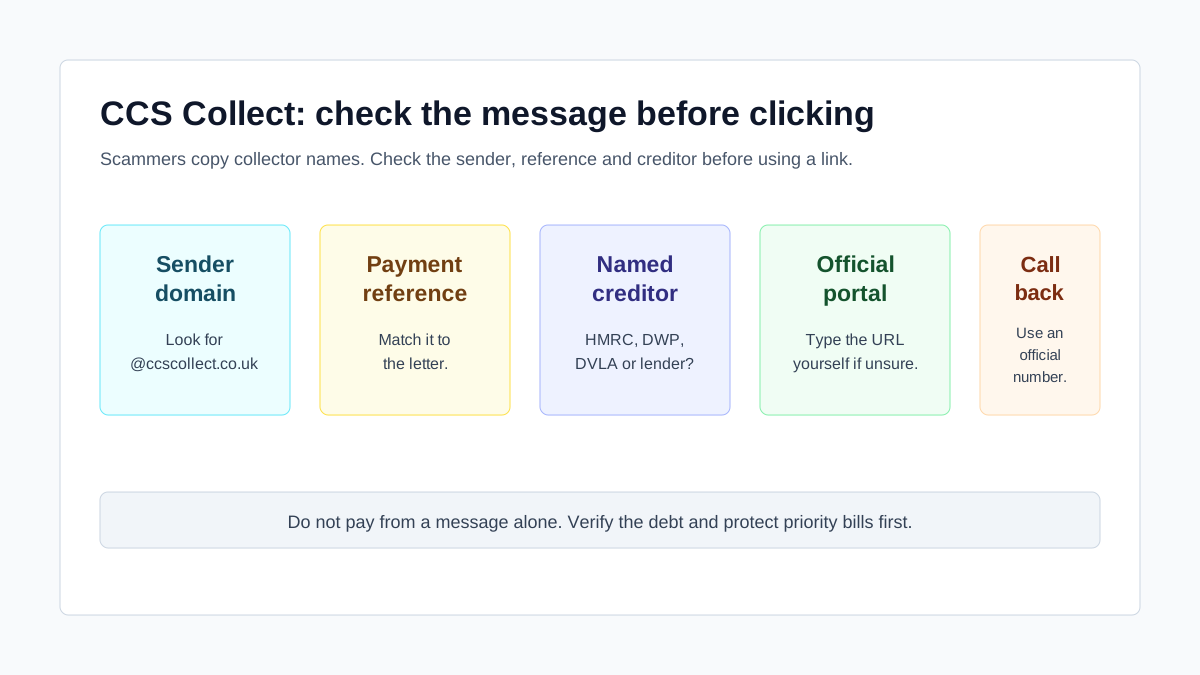
- “The email looks suspicious”: check the sender domain, payment reference, and the official CCS portal before clicking.
- “A doorstep visit is mentioned”: a CCS agent is not a bailiff and cannot force entry or take goods.
- “You cannot afford the amount requested”: send an income and expenditure budget and avoid unaffordable promises.
- “You have several debts”: compare debt help, DMP, DRO, and IVA options before paying one collector first.
Who Are CCS Collect? #
Full legal name: Commercial Collection Services Limited Company number: 02326104 (incorporated 7 December 1988) Registered office: Norfolk House (3rd Floor), Wellesley Road, Croydon, England, CR0 1GR Previous address: 797 London Road, Thornton Heath, Surrey, CR7 6YY (before December 2019 — don’t use this address) FCA authorisation: FRN 703390 Industry membership: Credit Services Association (CSA) — long-standing member Data protection: ICO registered Website: ccscollect.co.uk Payment portal: portal.ccscollect.co.uk
CCS Collect is a contingency collector. That means they don’t own your debt. They collect on commission for the original creditor — HMRC, your utility company, whoever you originally owed money to. The debt remains with the original creditor, and CCS is just the middleman.
That distinction is important. CCS’s own website says they are not debt buyers and collect on behalf of a wide range of household names, while GOV.UK lists CCS Collect, also known as Commercial Collection Services Ltd, as one of the debt collection agencies HMRC may use. If a letter says HMRC is the creditor, check it through GOV.UK or your HMRC account before using any payment link in the message. If the debt is commercial or utility-related, ask CCS for the client name and account reference so you can verify it with the original provider.
The BPO Collections Ownership Change (November 2024) #
This is a major change that almost nobody else covers.
Historically, CCS Collect was owned by CCS Group Holdings Ltd. In November 2024, corporate filings show that BPO Collections Limited was notified as a person with significant control, succeeding CCS Group Holdings Ltd.
BPO Collections is itself a major debt collection agency also on the HMRC panel, based in Scotland. This means CCS Collect and BPO Collections now share the same parent structure and management.
Key directors appointed in November 2024 include:
- John Edward Adderley
- Catherine Victoria Grant Beattie
- Ferron Paul Billy
- Graham Rankin
Later appointments:
- Allan Scullion (November 2025)
- Alasdair Calderwood Skeoch (September 2025)
Graham Rankin and Alasdair Skeoch are central to BPO Collections’ operational leadership. If you’ve been contacted by both CCS Collect and BPO Collections about different debts — or even the same debt — this is why. They’re now part of the same management structure.
Is CCS Collect Fake? Why People Think It’s a Scam #
This is one of the most-searched questions about CCS Collect, and the suspicion is completely understandable.
CCS Collect is real and FCA-authorised. They’re not a scam. But there are several reasons why people doubt them:
Reason 1: You Weren’t Expecting Anyone Other Than HMRC to Contact You #
If CCS is chasing you for tax debt, you probably expected all communication to come directly from HMRC. Most people don’t know that HMRC outsources debt collection to a panel of private agencies — and CCS Collect is one of them.
HMRC sends its own reminders first. Then they send a “Final Opportunity Letter” warning that your debt will be transferred to an agency. Then CCS writes on branded stationery identifying their authority to act on behalf of HMRC. But if you missed those earlier letters, a sudden letter from “Commercial Collection Services” in Croydon feels random and suspicious.
Reason 2: The Payment Portal URL Changes #
CCS Collect’s official website is ccscollect.co.uk, which links to portal.ccscollect.co.uk. Open the portal from the official website rather than relying on a different address in a message.
A separate portal can be legitimate, but that does not make every similar-looking domain safe. Check the destination independently before signing in or entering card details.
Reason 3: Confusion with US Companies #
There’s a US-based firm called “Credit Collection Services” (or “CCS Offices”) based in Massachusetts. That company generates a lot of scam complaints and warnings online.
When UK debtors search for “CCS Collect scam” or “is CCS fake,” they find these US-focused forum posts and assume it’s the same company. It’s not. The UK-based Commercial Collection Services Limited (CCS Collect) is a completely separate entity with no connection to the US firm.
Reason 4: Persistent Automated Calling #
CCS uses automated dialling systems to reach debtors by phone. Calls often display a 0208 area code (Croydon, South London). The persistence can feel aggressive — multiple calls per day, hang-ups if you answer, voicemails telling you to “call us urgently.”
This mimics the behaviour of scam call centres. But it’s CCS’s standard outbound process. It’s annoying, potentially harassing if excessive, but it’s not a scam.
How to Verify CCS Collect Is Real #
- Check GOV.UK’s list of authorised HMRC debt collection agencies. CCS Collect is on the official list.
- Call CCS directly on their published number (not a number provided in a suspicious email or text). Ask them to verify the debt and provide your unique reference number.
- Log into your Government Gateway account at gov.uk. If you owe tax to HMRC, it will show there.
- Check the FCA register at register.fca.org.uk. Search for FRN 703390 — Commercial Collection Services Limited. If it’s there and marked as “Authorised,” they’re legitimate.
If any of those checks fail, pause before paying. Do not give full bank details, National Insurance details or card information through a link sent in an unexpected text or email. Use CCS’s published contact page or the original creditor’s official contact route instead, and ask for written confirmation of the creditor, balance, reference and payment destination.
Why Is CCS Collect Contacting You? #
CCS collects debts for both government departments and commercial creditors. Here’s who they work for:
Government Clients #
HMRC (HM Revenue and Customs) CCS is on the official panel of debt collection agencies used by HMRC. They handle:
- Self-assessment income tax
- VAT (Value Added Tax)
- Corporation tax
- PAYE (Pay As You Earn) and National Insurance arrears
- Class 2 National Insurance contributions
CCS is often cited as specialising in smaller overdue balances and self-assessment tax, though they handle all types.
DWP (Department for Work and Pensions) CCS recovers benefit overpayments for the DWP. Parliamentary records show the DWP has used CCS for hundreds of thousands of “more difficult” cases where internal recovery has failed.
DVLA (Driver and Vehicle Licensing Agency) CCS handles DVLA vehicle-tax penalties. These are not parking charges: CCS explicitly says it does not act for parking operators. A text claiming to be from CCS that contains a Parking Charge Notice (PCN) number is a scam, according to CCS’s own warning. Do not use its payment link.
NHS Business Services Authority CCS recovers unpaid prescription charges and other health-related overpayments.
Local Authorities CCS collects council tax and business rates arrears for various councils across England and Wales.
Student Loans Company CCS recovers arrears on historical student loan accounts.
Commercial Clients #
Utilities: Thames Water, EDF, and other water and energy companies Financial services: Credit card issuers, high-street banks, personal loan providers Telecommunications: Mobile phone contracts, broadband bills Business-to-business (B2B): Commercial debt recovery for SMEs and larger corporations
The HMRC Transfer Process #
If CCS is chasing you for tax debt, here’s how you ended up with them:
- HMRC sends its own reminders — automated letters and potential SMS alerts directly from HMRC.
- The “Final Opportunity Letter” — HMRC warns that your debt will be transferred to an agency if you don’t pay or contact them.
- Agency appointment — Your debt is assigned to CCS Collect. They write to you on branded CCS stationery that clearly identifies their authority to act on behalf of HMRC.
- Verification period — You’re encouraged to verify this authority via the HMRC website, which maintains a list of authorised agencies.
- Agency-led negotiation — CCS attempts to secure full payment or a Time to Pay (TTP) arrangement.
- Case return — If CCS can’t secure payment or contact you after a set period, your case goes back to HMRC for more aggressive enforcement, such as an HMRC Field Force visit or court action.
CCS Collect and HMRC — Tax Debt #
If CCS is chasing you for HMRC debt, you need to understand the unique rules that apply.
HMRC Debt Has No Time Limit #
Unlike most debts, HMRC tax debt never becomes statute-barred. HMRC can pursue it indefinitely. There’s no 6-year limitation period. Even if you haven’t heard from HMRC in 10 years, they can still chase you for unpaid tax.
HMRC Does NOT Accept Settlement Offers #
If you owe £10,000 in tax, you can’t offer £5,000 to settle. HMRC expects 100% of the tax plus interest. They almost never accept partial settlements from solvent individuals or businesses.
The only exceptions are cases of genuine exceptional hardship (e.g., terminal illness, destitution) where HMRC may consider remission. But this is extremely rare.
Time to Pay (TTP) Arrangements #
CCS can facilitate a Time to Pay arrangement on behalf of HMRC. This is a monthly repayment plan.
- Standard term: Up to 12 months
- Longer terms: Up to 2 years in exceptional cases, but you’ll need to provide detailed evidence of hardship
- Interest: Statutory interest continues to accrue during the TTP. Your debt grows while you’re paying it off, just at a slower rate.
If you genuinely can’t afford a Time to Pay arrangement — even a long one — you may need to consider an IVA or other debt solution. Check if you qualify using our IVA calculator.
HMRC’s Unique Administrative Powers #
HMRC has enforcement powers that no other creditor possesses.
Tax code adjustment: HMRC can change your tax code to collect the debt directly from your wages. Your employer deducts the money before you even see it. This doesn’t require a court judgment.
Direct Recovery of Debts (DRD): HMRC can take money directly from your bank account to clear a tax debt — again, without needing to go to court. They must follow strict rules (leave you with at least £5,000, give advance notice) but they can do it.
Magistrates’ court proceedings: For certain debts (e.g., late filing penalties), HMRC can use magistrates’ court proceedings, which are faster and cheaper than County Court.
If CCS can’t resolve your case, it goes back to HMRC for escalated enforcement using these powers.
What If You Can’t Afford to Pay? #
If you have multiple debts beyond just HMRC, an Individual Voluntary Arrangement (IVA) may be an option. An IVA can include tax debt alongside commercial creditors. HMRC votes on IVA proposals and often accepts them if the offer represents better value than bankruptcy.
Use the IVA calculator to see if you qualify.
CCS Collect and the DWP — Benefit Overpayments #
The DWP uses CCS for “more difficult” benefit overpayment cases where internal recovery has failed. This includes overpayments of:
- Universal Credit
- Tax credits
- Jobseeker’s Allowance
- Employment and Support Allowance
- Housing Benefit
The DWP’s Unique Recovery Powers #
Deductions from ongoing benefits: If you’re still receiving benefits, the DWP can deduct the overpayment directly from your current payments. This happens automatically. CCS doesn’t need to be involved — the DWP does it at source.
Recovery even if statute-barred: The DWP can recover overpayments by deducting from ongoing benefits even if the debt would be statute-barred for court action. The 6-year limitation period doesn’t apply to administrative recovery from benefits.
If you’ve stopped claiming benefits, CCS may pursue the overpayment through standard collection methods — letters, calls, potentially a visit from a field agent.
Can You Challenge a Benefit Overpayment? #
If you believe the overpayment was caused by DWP error (not fraud or negligence on your part), you may be able to challenge it. Contact the DWP’s Debt Management contact centre to dispute the overpayment before CCS gets involved. Once it’s with CCS, your dispute must go back through the DWP.
CCS Collect Emails — How to Spot Fakes #
Scammers impersonate HMRC debt collectors to harvest banking details. These checks can flag a suspicious email, but a matching sender, reference or professional tone does not authenticate it. Sender details can be spoofed; confirm the message through CCS’s independently accessed official website.
Genuine CCS Collect Emails #
Sender domain: @ccscollect.co.uk Reference number: Contains your unique “CCS Payment Reference” which matches your physical letters Call to action: Directs you to the verified portal (portal.ccscollect.co.uk) or asks you to call the official CCS phone number Tone: Professional, identifies the original creditor, provides clear options Payment methods: Bank transfer, debit card via portal — traditional methods
Scam / Phishing Emails #
Sender domain: Generic domains like Gmail or Outlook, or misspelled lookalikes like @ccs-collections.com or @ccscollects.co.uk Reference number: Vague terms like “Your Case” or a completely generic number Call to action: Urgent demands like “Click here to stop legal action” or “Pay now via this link” Tone: High-pressure, threatening, vague about the debt Payment methods: Unusual requests for gift cards (iTunes, Amazon), cryptocurrency, or offshore wire transfers Data requests: Asks you to “verify” your full bank details, National Insurance number, or passwords upfront
What to Do If You’re Unsure #
Don’t click any links in the email. Open a new browser window and go directly to ccscollect.co.uk or call them on their published number. Ask them to verify whether they sent the email and confirm the details.
CCS Collect Letters and Phone Calls #
CCS uses a tiered contact strategy designed to maximise contact rates.
The Contact Sequence #
Pre-action letter — An introductory letter identifying the original creditor and the total amount owed. This is a legal requirement under the Pre-Action Protocol for Debt Claims.
Outbound phone calls — Automated dialling systems attempt to reach you. Calls often display a 0208 area code (Croydon). These are persistent but legitimate.
SMS/text alerts — Short messages like “Call us urgently” or “Visit the portal.” These are reminders, not threats.
Email correspondence — Digital notices for those who provided an email address to the original creditor.
Possible further recovery — The next step depends on the creditor and debt type. For HMRC debts, CCS must not visit your home or workplace. Any non-HMRC collection visit does not give an ordinary debt collector bailiff powers.
Can You Stop the Calls? #
Yes. Write to CCS requesting letter-only contact. Under FCA rules, they must honour this request. Send your letter to:
Commercial Collection Services Limited Norfolk House (3rd Floor) Wellesley Road Croydon England CR0 1GR
State clearly: “I request that all future contact regarding [account reference] be in writing only. Do not call my phone or send text messages.”
Keep a copy of your letter. If they continue calling after receiving your request, that’s a breach of FCA rules and you can complain to the Financial Ombudsman Service.
Can CCS Collect Send Bailiffs? #
HMRC exception: CCS must not visit your home or workplace for HMRC debt. The discussion below distinguishes ordinary collectors from any separately authorised enforcement agent.
No. CCS field agents are NOT bailiffs.
This is the most important thing to understand if someone from CCS knocks on your door.
CCS Doorstep Agents vs Court-Appointed Bailiffs #
| Feature | CCS Collect Doorstep Agent | Court-Appointed Bailiff |
|---|---|---|
| Legal basis | Acting on behalf of a private agency/creditor | Acting with a court-issued warrant or writ |
| Power of entry | No right of entry. Must leave if asked. | Can force entry in specific cases (e.g., criminal fines or HMRC debt with a warrant) |
| Asset seizure | Cannot seize goods | Can take control of goods to be sold at auction |
| Primary role | Discussion, negotiation, delivering notices | Enforcement of a court judgment or statutory power |
What to Do If a CCS Agent Visits #
- Ask for identification. They should have an ID card showing they represent CCS Collect.
- You do not have to let them in. Tell them to leave. If they refuse, that’s harassment.
- Request letter-only contact. Say, “Please leave. Send all future communication in writing.”
- Do not sign anything unless you fully understand what you’re agreeing to and you’re certain you can afford it.
- Do not make a payment on the doorstep unless you’re confident the debt is yours and you want to pay it.
If a CCS agent becomes aggressive, threatening, or refuses to leave when asked, this is a breach of FCA rules. Document what happened and complain.
Can You Settle a CCS Collect Debt for Less? #
It depends on the type of debt and who the original creditor is.
Commercial Debts (Banks, Utilities, Telecoms) #
Possible. CCS is a contingency collector, so they don’t own the debt — but they can negotiate settlement offers on behalf of the original creditor.
Typical settlement ranges:
- Newer debts (under 3 years old): 80-90% of the balance
- Older debts: Potentially lower, though less common for “transferred” debt than for “purchased” debt
Get it in writing. Before you pay a penny, get a written agreement from CCS (or the original creditor) confirming:
- The settlement amount
- That paying this amount will clear the debt in full
- That no further balance will be pursued
Credit file impact: A settled debt shows as “Settled” (partially paid) not “Satisfied” (paid in full) on your credit report. This negative mark stays for 6 years from the date of settlement.
HMRC Tax Debt #
Almost never. HMRC expects 100% of the tax plus interest. They do not negotiate “full and final” settlements for solvent individuals or businesses.
The only option is a Time to Pay arrangement (see above) or, in cases of extreme hardship, applying for remission. Remission is rare and requires evidence like terminal illness or destitution.
DWP Benefit Overpayments #
Limited negotiation. The DWP can deduct from ongoing benefits regardless of what you negotiate with CCS. If you’re no longer claiming, CCS may accept a settlement, but you’ll need to negotiate with the DWP, not CCS directly.
DVLA Fines #
Generally full payment required. The DVLA rarely accepts partial settlements for vehicle excise duty or penalties.
Multiple Debts? Consider an IVA #
If CCS is chasing you for a commercial debt such as a bank, utility, or telecom account and you have other unaffordable debts, an IVA may stop direct contact for included qualifying debts once approved.
HMRC debt can also be included in an IVA. HMRC votes on proposals and often accepts them if the offer is reasonable.
Use the IVA calculator to check if you qualify.
Is Your CCS Collect Debt Statute-Barred? #
A debt becomes “statute-barred” (also called “time-barred” or “prescribed”) after a certain period. The creditor can no longer take you to court to recover it, though the debt itself doesn’t disappear.
Standard Limitation Periods #
England and Wales: 6 years (Limitation Act 1980) Scotland: 5 years (Prescription and Limitation (Scotland) Act 1973) — after 5 years, the debt is legally extinguished, not just unenforceable
The clock starts from:
- The date of your last payment, OR
- The date you last acknowledged the debt in writing, OR
- The date a County Court Judgment (CCJ) was issued (if a CCJ exists before the 6/5 years expire, the debt remains enforceable indefinitely)
Critical Exceptions for CCS Collect Debts #
HMRC tax debt: NO TIME LIMIT. Tax debt never becomes statute-barred. HMRC can pursue it indefinitely. Plus, HMRC has administrative powers (tax code changes, direct bank account recovery) that don’t require court action, so the limitation period doesn’t even apply to these methods.
DWP benefit overpayments: The 6-year limitation applies to court action, but the DWP can recover overpayments through deductions from ongoing benefits even if the debt is technically statute-barred for court purposes.
Council tax: Different rules apply depending on the local authority and whether a liability order has been issued. See our council tax arrears guide for specifics.
What to Do If You Think Your Debt Is Statute-Barred #
- Do NOT make a payment. This restarts the clock.
- Do NOT acknowledge the debt in writing. Saying “I owe this but can’t pay” counts as acknowledgment and restarts the clock.
- Write to CCS stating that you believe the debt is statute-barred under the Limitation Act 1980 (or Prescription Act for Scotland). Request that they cease collection activity.
- Keep evidence. Keep copies of all letters, bank statements showing no payments, and CCS’s response.
Under FCA rules, if you inform CCS that the debt is statute-barred, they must cease collection activity unless they can prove the limitation period has not passed.
For more detail, see our statute of limitations help and advice page.
Your Rights When Dealing with CCS Collect #
CCS Collect is regulated by the Financial Conduct Authority. They must comply with FCA rules, which include:
Treating Customers Fairly (TCF) #
- No aggressive practices, harassment, or misleading statements
- Cannot misrepresent their powers (e.g., claiming they’re bailiffs when they’re not)
- Cannot contact you at unreasonable times (e.g., late at night, early morning)
- Cannot discuss your debt with third parties (neighbours, family, employers) without your permission
Vulnerable Customer Protections #
CCS must identify and support vulnerable customers. If you have mental health issues, serious illness, disability, or other vulnerabilities, tell CCS in writing. They must:
- Stop aggressive collection tactics
- Provide extra time to respond
- Offer alternative communication methods
- Consider suspending collection activity while you seek debt advice
Your Right to Request Letter-Only Contact #
You can request that CCS stop calling and texting you. Write to them requesting letter-only contact (address above). They must honour this.
Your Right to Request a Return to the Original Creditor #
Since CCS doesn’t own your debt, you can ask them to return your account to the original creditor. Write to CCS stating: “I request that you return my account to [original creditor]. I will deal with them directly.”
CCS may comply, or they may refuse if they have a contract with the creditor to pursue the debt. But it’s worth trying, especially if you prefer dealing with the original creditor.
Your Right to See the Original Credit Agreement (Commercial Debts Only) #
For commercial debts regulated under the Consumer Credit Act 1974 (credit cards, loans, hire purchase), you have the right to request a copy of the original credit agreement.
Write to CCS requesting the agreement under Section 77 or 78 of the Consumer Credit Act 1974 (s77 for fixed-sum credit like loans; s78 for running-account credit like credit cards). Include a £1 postal order or cheque.
If CCS (or the original creditor) can’t provide a properly executed agreement, the debt becomes unenforceable.
Important: This right does NOT apply to HMRC, DWP, DVLA, or other government debts. It’s for commercial credit agreements only.
How to Stop CCS Collect Contacting You #
You have several options depending on your situation.
Option 1: Pay the Debt or Set Up a Repayment Plan #
The most straightforward way to stop CCS contacting you is to clear the debt. If you can’t pay in full:
- Negotiate a repayment plan you can afford
- For HMRC debt, ask CCS to facilitate a Time to Pay arrangement
- Get the agreement in writing before making any payments
Option 2: Request Letter-Only Contact #
If the phone calls and texts are causing stress, write to CCS requesting letter-only contact. They must stop calling you.
Option 3: Dispute the Debt #
If you don’t believe you owe the debt, write to CCS disputing it. Request:
- Proof that the debt is yours
- A full breakdown of the amount owed
- Proof that CCS has authority to collect on behalf of the original creditor
CCS must investigate and provide evidence. If they can’t, they should return the account to the original creditor or close the case.
Option 4: Breathing Space #
If you’re struggling with multiple debts, you can apply for Breathing Space — a 60-day legal protection that stops most creditors (including CCS) from contacting you, adding interest, or taking enforcement action.
Contact a debt advice charity like StepChange or Citizens Advice to apply, or read our Breathing Space guide.
Option 5: IVA or Trust Deed #
An Individual Voluntary Arrangement (IVA) in England and Wales, or a Trust Deed in Scotland, is a formal debt solution that may reduce what you repay if it is suitable, accepted, and completed.
Once your IVA or Trust Deed is approved, CCS should stop direct contact for debts included in the arrangement. All contact usually goes through your insolvency practitioner or trustee.
HMRC debts can be included. Check if you qualify using the IVA calculator.
Option 6: If the Debt Is Statute-Barred #
If you believe the debt is statute-barred (over 6 years old in England/Wales, over 5 years in Scotland), write to CCS stating this. They must cease collection unless they can prove otherwise.
Exception: HMRC and certain other government debts are never statute-barred.
CCS Collect Contact Details #
Phone: 020 8665 4929, published on the official CCS website and checked 5 September 2026. Address: Commercial Collection Services Limited Norfolk House (3rd Floor) Wellesley Road Croydon England CR0 1GR
Website: ccscollect.co.uk Payment portal: portal.ccscollect.co.uk
Complaints: Write to the above address marked “Complaints Department” — Attention: Complaints Manager
If unresolved after 8 weeks: Financial Ombudsman Service
FCA register: Check FRN 703390 at register.fca.org.uk
How to Complain About CCS Collect #
If CCS has broken FCA rules (harassment, misrepresentation, refusing to honour letter-only contact requests), follow these steps:
Step 1: Complain Directly to CCS in Writing #
Send a formal complaint letter to:
Commercial Collection Services Limited Norfolk House (3rd Floor) Wellesley Road Croydon England CR0 1GR
Mark the envelope: Complaints Department
State clearly:
- Your name, address, and CCS account reference
- What CCS did wrong
- When it happened
- What you want them to do (e.g., stop contacting you, remove negative credit file entries, compensate you)
Keep a copy of your letter and send it by recorded delivery.
Step 2: Financial Ombudsman Service (8 Weeks Later) #
If CCS doesn’t respond within 8 weeks, or if you’re unhappy with their response, escalate to the Financial Ombudsman Service (FOS).
The FOS is a free, independent complaints service. They can order CCS to:
- Pay you compensation
- Stop collection activity
- Correct your credit file
- Refund unfair charges
Contact the FOS at financial-ombudsman.org.uk or call 0800 023 4567.
Step 3: Report FCA Rule Breaches #
If CCS has committed serious breaches (e.g., threatening violence, repeatedly contacting you after being told to stop), report them to the Financial Conduct Authority.
You can’t complain directly to the FCA about your individual case, but they track patterns of misconduct and may investigate CCS if multiple complaints are made.
Report at fca.org.uk/consumers.
Step 4: Data Protection Issues #
If CCS has mishandled your personal data (e.g., disclosed your debt to a third party, refused to provide information you requested under GDPR), complain to the Information Commissioner’s Office (ICO).
Report at ico.org.uk/make-a-complaint.
Complaints About HMRC Debt Collection #
If CCS is collecting for HMRC and you believe HMRC should never have sent the debt to them (e.g., you’d already set up a payment plan), complain to HMRC directly as well.
HMRC complaints: gov.uk/complain-about-hmrc
If you’re struggling with debt and want to compare your options, use our free IVA calculator to check whether an IVA may be suitable.
Frequently Asked Questions #
What does CCS Collect stand for? #
Commercial Collection Services. The full legal name is Commercial Collection Services Limited. CCS Collect is their trading name.
Is CCS Collect a real company? #
Yes. CCS Collect is a legitimate debt collection agency registered in England since 1988 (company number 02326104). They’re authorised by the FCA (FRN 703390) and are members of the Credit Services Association.
Are CCS Collect and BPO Collections the same company? #
Since November 2024, BPO Collections Limited has been the person with significant control over CCS Collect. They share the same parent structure and management. If you’re contacted by both agencies, this is why — they’re now part of the same group.
Can CCS Collect take money from my bank account? #
CCS does not gain power to take money from your account merely by collecting a debt. A payment normally needs your authorisation. A creditor with a judgment may seek a third-party debt order through the court; HMRC has separate Direct Recovery of Debts powers subject to safeguards. Those HMRC powers do not belong to CCS.
Can CCS Collect affect my credit score? #
The effect depends on the underlying debt and any credit reporting or court judgment, not simply on receiving a CCS letter. Do not assume every HMRC or government debt is routinely reported like a credit-card default. Check your credit files and ask the relevant creditor to correct inaccuracies.
Do HMRC really use CCS Collect? #
Yes. GOV.UK lists CCS Collect, also known as Commercial Collection Services Ltd, among the agencies HMRC may use. Verify a tax-debt letter through your HMRC account or official GOV.UK contact details. HMRC’s collection agencies may contact you by letter, text or phone, but must not visit your home or workplace.
Can I ignore CCS Collect? #
Do not ignore a debt letter or court deadline. Verify the sender and debt, dispute errors in writing, and ask for debt advice if payment is unaffordable. Further action depends on the creditor and debt type; court enforcement is not automatic and CCS cannot use HMRC’s powers itself.
What happens if I don’t pay CCS Collect? #
CCS may continue permitted contact or return the case to the creditor, which may consider further recovery. The process depends on the debt: ordinary court claims, HMRC powers and benefit deductions are different routes with different safeguards. A doorstep visit is not an allowed step for CCS when collecting HMRC debt. Seek advice promptly rather than agreeing to payments you cannot afford.
Can CCS Collect visit my home? #
For HMRC debts, CCS must not visit your home or workplace. For other debts, an ordinary collection agent is not a bailiff and cannot force entry or seize goods. You can refuse entry and ask them to leave. Get advice if a visitor claims enforcement powers, and check the notice and original creditor.
Is the CCS Collect email genuine? #
A familiar sender address or payment reference does not prove an email is genuine: sender details can be spoofed. Navigate independently to ccscollect.co.uk and check your account or contact CCS using its published details. CCS warns that texts containing a PCN number are fraudulent because it does not act for parking operators. Do not enter payment details through a suspicious link.
Need help with multiple debts? If CCS Collect is chasing you and you have other unaffordable debts, use our IVA suitability check to see whether an IVA may fit your situation.
For general debt help, including free advice services, visit our debt help page.