
If you’ve received a letter from Cabot Financial and you’re feeling worried, you’re not alone. This page explains who Cabot are, what powers they actually have, and the practical options available to you right now.
Quick decision guide #
- “We now own this debt”: ask for the Notice of Assignment and check the balance against your records.
- “Pay today to avoid escalation”: ask for everything in writing and do not agree to unaffordable payments.
- “Legal action may follow”: a Letter Before Claim or court form is the point to treat as urgent.
- “We can offer a settlement”: get any full and final settlement confirmed in writing before paying.
- “A field agent may visit”: a field agent is not a bailiff, and you do not have to let them in.
If Cabot is one of several creditors, compare the full debt picture before paying one account in isolation. A Debt Management Plan, Debt Relief Order, IVA, or another route may be more stable than separate arrangements with every collector.
Check a Cabot letter before you pay #
Before paying Cabot or setting up a plan, separate three questions:
- Is the contact genuine? Cabot Financial (Europe) Limited is registered at Companies House under company number 03439445, and Cabot’s own site gives its registered office at 1 Kings Hill Avenue, Kings Hill, West Malling, Kent ME19 4UA. Do not rely only on a phone number in a text message.
- Does Cabot own or service this account? If the letter says the debt has been assigned, ask for the Notice of Assignment and check the original creditor, account reference, balance and default date.
- Is there a deadline? Ordinary collection letters can be handled in writing. A Letter Before Claim, county court claim form or enforcement notice needs faster action because it can affect CCJ and bailiff risk.
If the balance is unaffordable and Cabot is only one creditor, avoid using all spare money on this account before checking the rest of your debts. A single settlement may help if it is affordable and confirmed in writing, but it can make priority bills, rent, council tax or other creditor deadlines worse.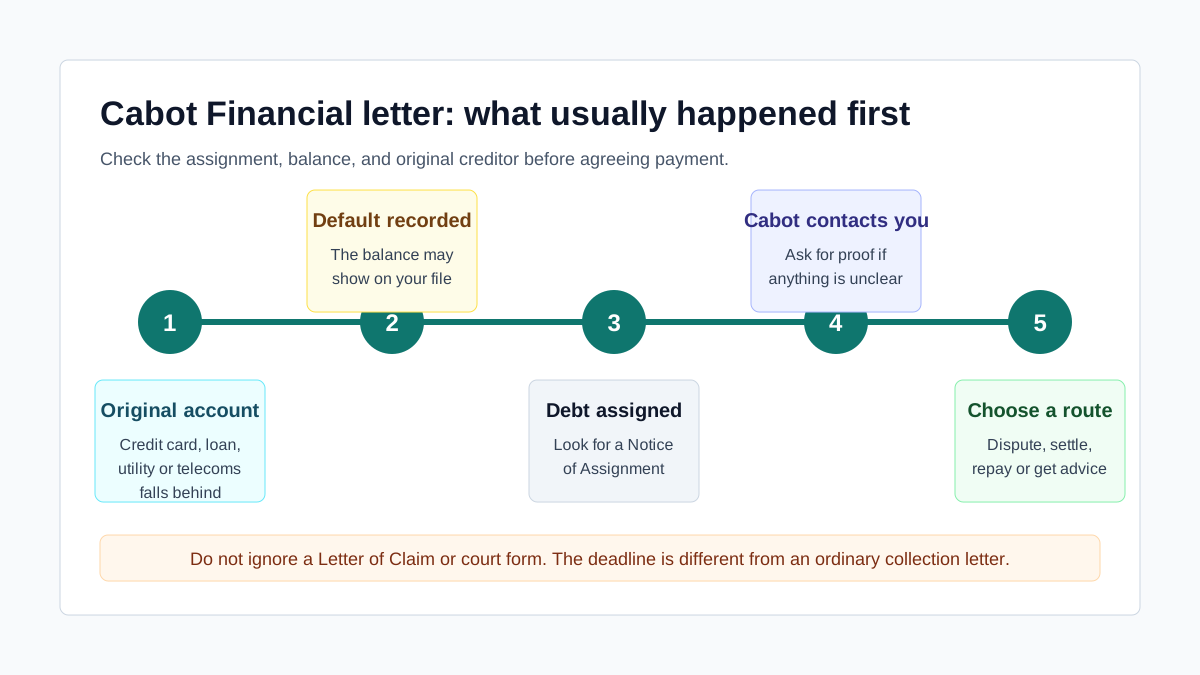
Who Are Cabot Financial? #
Cabot Financial is one of the UK’s largest debt purchasers, operating since 1998. They’re part of the Cabot Credit Management (CCM) Group Limited, one of Europe’s biggest credit management companies. Their headquarters are in West Malling, Kent, and Cabot Financial (Europe) Limited is an appointed representative of Cabot Credit Management Group Limited, which is FCA-authorised under reference 677910. They’re also members of the Credit Services Association, which means they’re supposed to follow industry standards for debt collection.
Here’s the key thing to understand: Cabot don’t lend money. They buy debts from other companies at a fraction of what you originally owed, then chase you for the full amount. That’s their business model. If you owed £5,000 to Barclaycard, Cabot might have bought that debt for £500 or less. They then contact you demanding the full £5,000, keeping the difference as profit.
Cabot also operates under other names:
- Cabot Financial (Europe) Limited (company number 03439445)
- Cabot Financial (Marlin) Limited (company number 4618038)
- Marlin Capital Europe
- MCE Portfolio Limited
If you’ve never heard of Cabot before receiving their letter, that’s completely normal. Your original creditor sold your debt to them without necessarily telling you first. The Notice of Assignment letter you received is often the first time people learn their debt has been sold. This causes confusion because your original creditor’s account now shows as “Closed” on your credit file, and a new entry from Cabot appears. People think they’ve got two defaults. You haven’t. It’s the same debt, just transferred to a new owner.
Who Do Cabot Financial Collect For? #
Cabot buys debt portfolios from a wide range of companies. If you’ve fallen behind with any of these, your account may have been sold to Cabot:
Government and councils:
- HMRC (tax debts)
- DVLA (vehicle-related debts)
- Local councils
Utilities and energy:
- Scottish Power
- E.ON
- Shell Energy
- NPower
- First Utility
Banks and finance:
- Barclays
- HSBC
- Various credit card providers
- Personal loan companies
- Overdrafts
Telecoms:
- O2
- Mobile phone contracts
- Broadband providers
When your debt gets sold, the original company receives a fraction of what you owed. They’ve written it off as a loss. Cabot then becomes your new creditor. They own the debt. That’s why they’re contacting you, not the original lender. The original lender has washed their hands of it.
What Happens If You Ignore Cabot Financial? #
Ignoring Cabot won’t make them go away. In fact, it makes things worse. Here’s the escalation process they typically follow:
Stage 1: Letters and Calls You’ll receive multiple letters and phone calls. They’ll start polite, offering payment plans. These become more frequent and more urgent over time. Expect calls during working hours, evenings, and weekends.
Stage 2: Home Visit Warning If you don’t respond, they’ll send a letter saying a field agent will visit your home. This is designed to scare you into calling them. The agents have no special powers, but a knock on the door is stressful.
Stage 3: Door-to-Door Collector An agent may turn up at your home. You do not have to let them in. They can’t force entry. They can only stand at your door and ask you to make arrangements. It’s embarrassing and uncomfortable, but they can’t take anything or arrest you.
Stage 4: Letter Before Action This is the serious one. It’s a formal legal notice that they intend to take you to court. It usually gives you 7 days to pay in full or agree to a repayment plan. This is your final warning before court action.
Stage 5: County Court Claim (Form N1) If you don’t respond to the Letter Before Action, they’ll issue a county court claim. You’ll receive an official court form giving you 14 days to respond. You can either admit the debt and offer payment, or dispute it. If you do nothing, they get a County Court Judgment by default.
Stage 6: County Court Judgment A CCJ goes on your credit file for 6 years. It destroys your credit rating. Banks won’t lend to you. Mortgage applications get rejected. Even mobile phone contracts become difficult.
Stage 7: Enforcement With a CCJ, Cabot can apply for:
- Attachment of earnings (money taken directly from your wages)
- Charging order (a legal charge against your property)
- Bailiff enforcement (certified bailiffs with powers to enter your home and seize goods)
Each stage costs you more. Court fees, bailiff fees, enforcement fees. What started as £2,000 can balloon to £3,000 or more if you ignore it all the way to enforcement.
Can Cabot Financial Send Bailiffs? #
No. Cabot Financial are debt collectors, not bailiffs. There’s a massive difference.
What Cabot’s agents CAN do:
- Send letters to your home
- Phone you
- Visit your home and knock on the door
- Ask you to make payment arrangements
What Cabot’s agents CANNOT do:
- Force entry into your home
- Enter your home without permission
- Take your belongings
- Threaten you with arrest
- Pretend to be bailiffs or court officials
- Speak to your neighbors about your debt
- Contact you at work if you’ve asked them not to
You do not have to let Cabot’s door-to-door collectors into your home. If they turn up, you can speak to them through the door, or not at all. They have no right to enter.
The only way Cabot can use actual bailiffs is by going through the courts. They need to:
- Take you to court and get a County Court Judgment
- Wait for you to fail to pay the CCJ
- Apply to the court for a warrant of control
- Pay the court fees and bailiff fees
Only then can certified enforcement agents (bailiffs) get involved. Even then, bailiffs can only enter through unlocked doors or peaceful entry on the first visit. They need a warrant. Cabot’s own staff have none of these powers.
Can Cabot Financial Take You to Court? #
Yes. Taking you to court is the main tool Cabot have if you won’t pay. Here’s how it works:
A county court claim may arrive by post or through an online court service. Follow the response route and deadline on the claim. You may be able to request extra time to defend it, but must do so within the applicable deadline. GOV.UK explains how to respond. You can:
Admit the debt: You agree you owe it. You can offer to pay in installments based on what you can afford. The court will decide if your offer is reasonable.
Dispute the debt: You don’t think you owe it, or you don’t think the amount is correct. You’ll need evidence. This forces Cabot to prove the debt is yours and the amount is accurate.
Do nothing: This is the worst option. The court awards a CCJ by default. Cabot win without even having to prove anything.
A CCJ normally remains on the register and your credit file for six years. If you pay the full judgment within one calendar month, you can ask the court to remove it from the register, providing proof of payment. This is cancellation following prompt payment, not a set-aside application. A set-aside is a separate court procedure for challenging a judgment. See GOV.UK’s CCJ guidance.
After they have a CCJ, Cabot can apply for enforcement. The court can order your employer to deduct money directly from your wages (attachment of earnings). They can put a charging order on your house, which means if you sell, they get paid first from the proceeds. They can send certified bailiffs to seize your belongings and sell them at auction.
Do not assume a small balance prevents a court claim. Cabot may pursue debts of different sizes, and recoverable costs can be added. Treat an actual Letter of Claim or court claim as urgent whatever the amount.
How to Stop Cabot Financial Contacting You #
There are several ways to stop Cabot chasing you, depending on your situation:
1. Enter a formal debt solution
If you qualify for an Individual Voluntary Arrangement, Debt Management Plan, Debt Relief Order, or another protected route, Cabot should be told through the correct advisor or insolvency process. An IVA can stop direct contact for included qualifying debts once approved, but it is a formal insolvency solution and needs careful advice.
2. Pay the debt or negotiate a settlement
If you can afford to pay, contact Cabot directly. Paying clears the debt. They stop chasing you because there’s nothing left to chase. See the next section for how to negotiate a lower amount.
3. Request written communication only
You can ask Cabot to stop phoning you and only contact you in writing. Send them a letter (keep a copy) stating:
- You want all future contact in writing only
- They should not phone you
- They should not visit your home
They should comply with this. If they don’t, you can complain to the Financial Ombudsman Service. This won’t stop the debt existing, but it stops the harassment.
4. Prove the debt or challenge it
If you don’t think you owe the debt, or the amount is wrong, send Cabot a “prove it” letter. Under FCA rules (CONC 7.14), if a customer disputes the debt, the firm must stop demands for payment until they can prove:
- You are the correct person
- The debt is yours
- The amount is accurate
Ask for:
- A copy of the credit agreement and applicable terms
- A full breakdown of the amount claimed
- Evidence that Cabot legally owns the debt
Do not assume a missing original signature automatically makes a debt unenforceable. For eligible Consumer Credit Act requests, the creditor can provide a compliant copy without the original signature. Failure to meet a valid statutory information request can temporarily restrict enforcement, but it does not write off the balance or cancel a court deadline. Read National Debtline’s credit-agreement guidance and get advice before relying on unenforceability.
5. Check if the debt is statute-barred
Many simple contract debts in England and Wales have a six-year limitation period. Check:
- when the creditor first became entitled to bring the claim;
- any later payment or written acknowledgement;
- whether court action or a judgment already exists.
The age of a default alone is not enough to decide this. Payments and written acknowledgements can affect a running limitation period. Scottish prescription rules differ and can extinguish many debts after five years if the conditions are met. A CCJ needs separate advice.
If you think a time limit applies, get free debt advice before paying or acknowledging the debt. Use a statute-barred response only when the facts support it, and still respond to any court claim by its deadline. Read our statute-barred debt guide.
Can You Negotiate With Cabot Financial? #
Yes. Cabot are often willing to settle for less than the full amount, especially on older debts. Here’s why: they bought your debt cheap. If they paid £500 for a £5,000 debt, anything you pay over £500 is profit for them. They have room to negotiate.
Settlement offers that work:
For debts over 3 years old, start by offering 25-30% of the balance. If you owe £5,000, offer £1,250 to £1,900 as a “full and final settlement.” They might counter at 40-50%. You can meet in the middle.
For newer debts (under 2 years old), expect to pay 50-70% to settle. They’re less willing to discount recent purchases because they paid more for them.
How to negotiate:
Contact Cabot by phone or in writing. Explain your financial situation. If you’ve got a lump sum available (inheritance, redundancy, savings), that gives you leverage. Lump sums are attractive to debt collectors because they get cash immediately instead of waiting years for monthly payments.
Make your offer clear:
- “I can pay £1,500 today to settle this account in full and final.”
- “This is a one-time offer. If you don’t accept, I’ll be pursuing formal debt advice and you’ll likely get nothing.”
Get any agreement in writing before you pay. Do not hand over a penny until they send you a letter confirming:
- They accept your offer
- Upon receipt of payment, the account will be closed
- The remaining balance will be written off
- They will not pursue you for the remainder
Pay by bank transfer or debit card so you have proof of payment. Keep all paperwork. Once paid, check your credit file after 4-6 weeks to make sure they’ve marked the account as “Partially Settled” or “Settled.”
Warning about partial settlements:
If you settle for less than the full amount, it shows as “Partially Settled” on your credit file, not “Satisfied.” Future lenders can see you didn’t pay the full debt. This looks worse than a “Satisfied” marker, especially when applying for mortgages. Lenders see “Partially Settled” as meaning you abandoned some of your debt. If you can afford to pay the full amount, that’s better for your credit file long-term. But if it’s settle for 30% or don’t pay at all, settling is still the better option.
Is Cabot Financial Legitimate? #
Yes. Cabot Financial is a legitimate, regulated debt collection company. Cabot Financial (Europe) Limited operates as an appointed representative of FCA-authorised Cabot Credit Management Group Limited (FRN 677910). They’re not a scam. They’re one of the biggest debt purchasers in the UK, with over 25 years of operation.
But “legitimate” doesn’t mean they always behave perfectly. Common complaints about Cabot include:
- Calling repeatedly throughout the day and evening
- Contacting the wrong person (someone who doesn’t owe the debt)
- Refusing to provide proof of the debt
- Adding excessive charges to the account
- Threatening court action when they have no intention of following through
- Visiting homes and behaving aggressively
If Cabot are harassing you, you have options. The FCA rules on debt collection (CONC 7.3) state firms must not:
- Contact you at unreasonable times (early morning, late evening)
- Contact you at work after you’ve asked them not to
- Disclose your debt to third parties (neighbors, family, employers)
- Pressure you to sell your home or take out more credit to pay
- Ignore evidence that you’re vulnerable (mental health, serious illness)
If Cabot break these rules, complain to them first. Send a formal complaint letter (keep a copy) outlining what happened and what you want them to do about it. They must investigate and respond within 8 weeks.
If you’re not satisfied with their response, escalate to the Financial Ombudsman Service:
- Phone: 0300 123 9123
- Email: complaint.info@financial-ombudsman.org.uk
The Ombudsman is free and independent. They can force Cabot to apologize, remove incorrect information from your credit file, or pay you compensation for distress.
Data protection and Subject Access Requests:
You have the right to see exactly what data Cabot holds about you. This is called a Subject Access Request (SAR). Send Cabot a letter (or email) asking for all personal data they hold, including:
- How they obtained your data
- What communications they’ve sent you
- Any recordings of phone calls
- Notes on your account
They normally have one month to respond, usually without a fee; extensions and exceptions can apply. See the ICO’s subject access guidance. This is useful because you can check if they’ve recorded your debt correctly, whether they’ve shared your data with anyone else, and whether they’ve made any errors. If Cabot have mishandled your data or breached the Data Protection Act 2018, you can claim compensation for any distress caused.
Cabot has had data breach issues in the past. If you believe your data was part of a breach, you can claim compensation from them directly or through the Information Commissioner’s Office.
How to Deal With Cabot Financial Debt #
Your options depend on whether you can afford to pay, and how much you owe in total.
If you can afford to pay:
Contact Cabot and negotiate. Try to settle for less than the full amount. Even if they won’t reduce the balance, you might be able to get them to freeze interest and charges. Get any agreement in writing. Pay by bank transfer so you have proof. Keep all paperwork.
Once you’ve paid, check your credit file after 4-6 weeks. Make sure Cabot have marked the account as “Satisfied” or “Partially Settled.” If they haven’t updated it, contact them with proof of payment and demand they correct your credit file.
If you can’t afford to pay, or you have multiple debts:
Formal debt solutions can help. The right one depends on your circumstances:
Individual Voluntary Arrangement (IVA): An IVA is a legally binding agreement with your creditors to pay what you can afford over 5-6 years. Some people have a portion of qualifying debt written off if creditors approve the IVA and it completes. Once your IVA is approved, included creditors such as Cabot should stop direct collection and deal with your insolvency practitioner.
You need:
- At least £6,000 of unsecured debt to 2 or more creditors
- Regular income (work or benefits) to make monthly payments
- At least £90-£100 per month spare after essential living costs
An IVA stops all the stress. One affordable monthly payment. No more phone calls. No more letters. At the end of 5-6 years, whatever’s left is gone. If you think this might suit you, check if you qualify using our IVA calculator. It takes 2 minutes and gives you an instant answer.
Read more: What is an IVA? | IVA pros and cons
Debt Management Plan (DMP): A DMP is an informal arrangement where a debt charity or company negotiates reduced payments with all your creditors. You make one payment to the DMP provider, they distribute it to your creditors. It’s not legally binding, so creditors can still chase you, but most will freeze interest if you’re in a DMP.
DMPs work if you can afford to pay your debts in full, you just need more time. There’s no debt write-off. You pay everything eventually. It can take 10-15 years for large debts.
Read more: DMP guide
Debt Relief Order (DRO): A DRO is like a mini-bankruptcy. There is no application fee (the £90 fee was abolished in April 2024) and it writes off all your debts if:
- You owe less than £50,000
- You have minimal assets (under £2,000)
- Your income is very low (under £75 per month spare)
A DRO lasts 12 months. During that time, creditors can’t chase you. After 12 months, the debts are gone. It’s the fastest debt solution. It goes on your credit file for 6 years but so does everything else. If you qualify, it’s often the best option.
Read more: DRO guide | How to write off debt
Bankruptcy: If you have no assets, very low income, and large debts you can’t pay, bankruptcy might be suitable. It usually lasts 12 months. All your debts are written off. But you lose control of your assets (the Official Receiver can sell your home, car, valuables). There are more restrictions on employment. It’s a last resort, but sometimes the right choice.
If Cabot is chasing you and you have other debts, check whether an IVA may be suitable before agreeing unaffordable payments. Use our IVA calculator.
What Happens After You Pay Cabot Financial? #
Paying Cabot doesn’t remove the debt from your credit file. It just changes the status.
Credit file update:
After full payment, check that Cabot reports the account as satisfied or settled. A discounted settlement may be recorded as partially settled. Ask when the update will be sent to the credit reference agencies, keep the settlement confirmation and dispute any inaccurate balance. Paying does not restart the original default’s six-year reporting period.
Lenders consider settled and unpaid accounts differently, but there is no guaranteed credit-score increase. The effect depends on the rest of your credit file and the lender’s own assessment.
If you had a County Court Judgment:
- Paid in full within one calendar month: send proof to the court and ask for the judgment to be removed from the register.
- Paid after one month: send proof to the court so the judgment can be marked satisfied. It normally remains registered for six years from the judgment date.
- Need a certificate: a certificate of cancellation (payment within one month) or satisfaction (later payment) currently costs £19. Apply in writing or using form N443. A certificate is evidence of the court record; do not confuse it with challenging a judgment using form N244.
GOV.UK explains how to notify the court, obtain a certificate and provide evidence if the creditor will not confirm payment. Keep copies and check that the register and credit files have been updated; court processing times can vary.
Rebuilding your credit:
A default normally drops off your credit file six years after its original date. That does not guarantee a particular score or a successful credit application. Before then, you can work on your wider credit record:
- Get a credit-builder card. Use it for small purchases. Pay the full balance every month. This shows lenders you can manage credit responsibly.
- Make sure you’re on the electoral register at your current address. This proves you are who you say you are.
- Don’t apply for lots of credit. Each application leaves a footprint on your file. Multiple footprints in a short time make you look desperate.
- Check your credit file for errors. Use Experian, Equifax, or TransUnion. If there are mistakes, dispute them.
It takes time. Paying bills on time and avoiding further missed payments can help your credit record, but there is no fixed timetable for obtaining a mortgage or mainstream credit. Other defaults, judgments, affordability and the lender’s criteria still matter after this default is removed.
Cabot Financial Contact Details #
Cabot Financial (Europe) Limited:
- Registered office: 1 Kings Hill Avenue, Kings Hill, West Malling, Kent, ME19 4UA
- Postal address: Cabot Financial, PO Box 241, West Malling, Kent, ME19 4UA
- Phone: 0344 556 0263
- Website: https://www.cabotfinancial.co.uk/
- Company number: 03439445
- Regulatory status: appointed representative of Cabot Credit Management Group Limited (FCA reference 677910)
Cabot Financial (Marlin) Limited:
- Registered office: Marlin House, 16-22 Grafton Road, Worthing, West Sussex, BN11 1QP
- Company number: 4618038
Parent company:
- Cabot Credit Management Group Limited (FCA authorised and regulated)
Complaints: If you’re unhappy with how Cabot have treated you, complain to them first. If they don’t resolve it, escalate to:
- Financial Ombudsman Service
- Phone: 0300 123 9123
- Email: complaint.info@financial-ombudsman.org.uk
- Online: financial-ombudsman.org.uk
If you’re struggling with debt and want to compare your options, use our free IVA calculator to check whether an IVA may be suitable.
Frequently Asked Questions #
Are Cabot Financial and Lowell the same company? #
No. Cabot Financial and Lowell are two separate companies. Both are large debt purchasers operating in the UK, but they’re competitors, not the same organization. Cabot is part of the Cabot Credit Management Group. Lowell is owned by a different parent company. If you owe money to both, they’re two separate debts that need handling independently.
Can Cabot Financial take money from my bank account? #
Cabot cannot take money from your account simply because it owns a debt. Payments need your authorisation, such as a direct debit, or a relevant court enforcement process. A judgment creditor can apply for a third-party debt order; an attachment of earnings order is different and directs an employer to deduct wages. Get advice promptly if court papers arrive.
How long can Cabot Financial chase a debt? #
Many simple contract debts in England and Wales have a six-year limitation period, but the starting point and effect of payments, written acknowledgments and court action matter. Scottish prescription rules are different and can extinguish many debts after five years if the conditions are met. A CCJ is not covered by the ordinary six-year rule for bringing a claim. Get debt advice before paying or acknowledging a potentially old debt.
What if Cabot Financial are chasing a debt that isn’t mine? #
Dispute the debt in writing and request evidence identifying the borrower, original creditor and balance. FCA rules require recovery to be suspended while a valid dispute is investigated. Keep copies and complain to Cabot first if it continues without resolving the issue. You may then be able to use the Financial Ombudsman Service. Report unresolved inaccurate personal-data handling to the ICO.
Will paying Cabot Financial improve my credit score? #
Payment updates the account’s settlement status, but no score increase is guaranteed. A default normally stays for six years from its original date, not the payment date. Check all relevant credit files and ask Cabot to correct inaccurate information.
Can Cabot Financial contact me at work? #
Tell Cabot in writing if workplace contact is inappropriate and ask for a suitable contact method. Collectors must respect reasonable requests about when, where and how to contact you and must not unfairly disclose the debt to other people. Keep a call log and complain to Cabot first if the problem continues; the Financial Ombudsman may be able to consider an unresolved complaint.