
If Bristow & Sutor have contacted you, you’re facing one of the UK’s largest enforcement companies: 450+ staff, 350+ clients, and contracts worth over £117 million with Transport for London alone. They collect council tax for 140+ local authorities and enforce Congestion Charge and ULEZ penalties for TfL.
But hundreds of Trustpilot reviews allege backdated letters—where the letter date is earlier than the postmark, meaning the seven-day response window expires before you’ve even seen it. Their rating is 1.3 out of 5.
This guide explains who Bristow & Sutor are, who owns them, and exactly how to stop them.
Quick answers #
Can Bristow & Sutor force entry for council tax? No. For council tax, parking fines, ULEZ, and Congestion Charge, they need peaceful entry only. Don’t let them in. Once inside, they can return with a locksmith if you breach a Controlled Goods Agreement.
Who owns Bristow & Sutor? Sovereign Capital Partners LLP, a private equity firm. The immediate parent company, Copper Bidco, operates out of Jersey.
Why is my letter arriving late? Multiple complaints allege backdated letters. Check the letter date against the postmark on the envelope. If the letter’s dated April 25th but arrived May 6th, the seven-day window has already expired. Keep the envelope—it’s evidence.
Can an IVA stop them?
Yes, an approved IVA can stop qualifying enforcement where the debt is included. Council tax and parking debts need careful handling, so get advice before relying on an IVA to stop a live visit.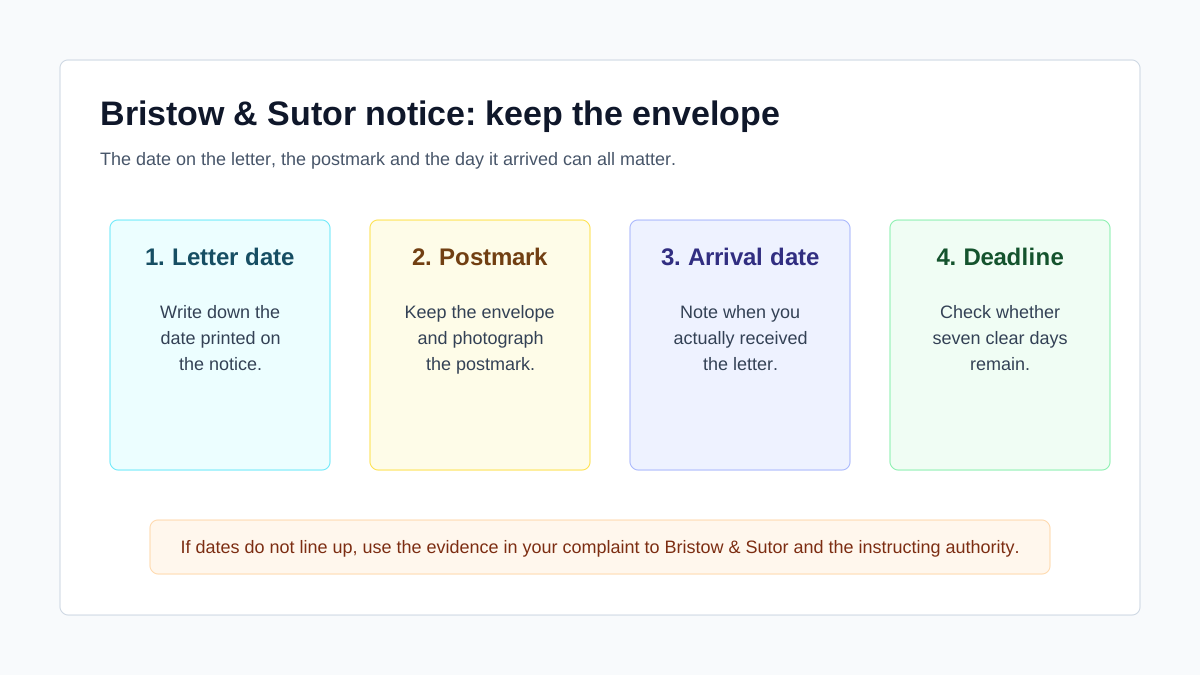
Table of Contents #
- Who are Bristow & Sutor?
- Who owns Bristow & Sutor?
- The £117 million TfL contract
- Which councils use Bristow & Sutor?
- What debts do they collect?
- Bristow & Sutor fees explained
- Can Bristow & Sutor force entry to my home?
- The backdating controversy—check your letter dates
- How to deal with Bristow & Sutor
- How to stop Bristow & Sutor
- How to complain about Bristow & Sutor
- Bristow & Sutor contact details
- Frequently Asked Questions
Who are Bristow & Sutor? #
Bristow & Sutor was founded in 1977 as a family-run bailiff business. In June 2017, the founding family sold the business in a Management Buyout valued at over £100 million to Sovereign Capital Partners, a private equity firm.
Since the buyout, the firm has expanded aggressively:
- Staff: Grew from 250 employees to over 450
- Clients: Now serving 350+ organisations, including 140+ local authorities
- Acquisitions: Bought Debt Recovery Plus (private parking enforcement) and Credit Style (litigation services)
Current directors:
- Richard James Sutor—the only remaining link to the founding family
- Brian William Maynard—appointed February 2022
- Susan Lesley Ring—COO, appointed February 2022
- Andrew Derek Vaughan—appointed June 2017 at the time of the MBO
ECB accreditation: Achieved in October 2023, meaning they’re bound by stricter standards including body-worn cameras and vulnerability protocols.
Learn more about bailiff regulations and your rights
Who owns Bristow & Sutor? #
Bristow & Sutor is owned by Sovereign Capital Partners LLP, a private equity firm founded by Lord John Nash (Conservative Party donor and former Schools Minister) and Ryan Robson.
The ownership structure:
- Sovereign Capital Partners LLP controls the business through Bb Shelf 4 LLP, which holds 75%+ of shares
- Copper Bidco (the immediate parent company) operates out of Jersey—a Crown Dependency with less public disclosure than UK-registered companies
- This private equity ownership means the business is optimised for investor returns through data-driven revenue maximisation
What this means for you:
When you’re negotiating with Bristow & Sutor, you’re dealing with a firm optimised for efficiency and returns, not debtor outcomes. Every decision is filtered through a data model designed to maximise revenue.
The £117 million TfL contract #
In May 2020, Transport for London awarded Bristow & Sutor a contract worth £117,154,333 to enforce non-payment of:
- Congestion Charge
- Low Emission Zone (LEZ)
- Ultra Low Emission Zone (ULEZ)
The contract runs until April 2025.
Contract requirements:
Bristow & Sutor must:
- Issue a Notice of Enforcement within two business days of receiving the warrant
- Contact debtors at least once daily via telephone, at variable times
- Complete mandatory tracing and DVLA checks before enforcement
This contract processes hundreds of thousands of enforcement actions annually. If you’ve been caught by a camera entering the ULEZ without paying, Bristow & Sutor will likely be chasing you.
Which councils use Bristow & Sutor? #
Bristow & Sutor collects council tax, business rates, and parking fines for over 140 councils across England and Wales.
Major clients:
- Manchester City Council – 8,459 households referred in 2021/22
- Leicester City Council – Sundry debt enforcement
- Sheffield City Council – Bus gate PCN enforcement (40,017 fines)
- Derby City Council – Council tax and business rates
- Norfolk County Council – Road traffic debt
- Cheshire West and Chester – General bailiff services
Why councils choose them:
Bristow & Sutor pitches “compliance stage” recovery—getting you to pay before an agent visits. This looks better in council reports than aggressive door-knocking. They also provide the technology infrastructure councils need for modern enforcement.
What debts do Bristow & Sutor collect? #
Bristow & Sutor enforces a wide range of debts:
- Council Tax – After the council obtains a Liability Order
- Business Rates (NNDR) – Commercial property rates
- Parking Fines (council-issued) – Via Traffic Enforcement Centre warrants
- Parking Charges (private land) – Via their Debt Recovery Plus subsidiary
- Congestion Charge / ULEZ / LEZ – For TfL under the £117m contract
- Dart Charge – Dartford Crossing toll recovery for National Highways
- High Court Writs – Commercial debts and larger court judgments
- Road Traffic Penalties – Magistrates’ court fines
Each debt type has different rules about entry, fees, and what goods can be seized.
Current non-High-Court fees #
For applicable cases in England and Wales received by the enforcement agent on or after 1 May 2026:
| Stage | Fixed fee | Percentage fee |
|---|---|---|
| Compliance | £79 | None |
| Enforcement | £247 | 7.5% of the debt above £1,900 |
| Sale or disposal | £116 | 7.5% of the debt above £1,900 |
Earlier cases can remain on the previous £75/£235/£110 table. Permitted disbursements can also apply. Ask for the case-received date and written calculation.
Current High Court fees #
For applicable High Court cases received from 1 May 2026:
| Stage | Fixed fee | Percentage fee |
|---|---|---|
| Compliance | £79 | None |
| First enforcement | £200 | 7.5% of the debt above £1,200 |
| Second enforcement | £520 | No percentage; only where the amended trigger is met |
| Sale or disposal | £550 | 7.5% of the debt above £1,200 |
High Court VAT and disbursement questions can be fact-specific. Ask for the writ, stage trigger and itemised calculation.
Notice period and late delivery #
For applicable cases received from 1 May 2026, a Notice of Enforcement normally allows at least 14 clear days before goods are taken. A timely request by a debt advice provider for a qualifying non-business debt can extend this to at least 28 clear days. A court can authorise a shorter period.
If the envelope suggests the notice was posted late, keep it and write down the arrival date. Ask Bristow & Sutor and the creditor to pause the case while they review the evidence. The evidence can support a complaint, but lateness does not automatically invalidate the underlying debt.
Can Bristow & Sutor force entry to my home? #
For council tax, parking fines, ULEZ, Congestion Charge, Dart Charge: NO
Bristow & Sutor cannot force entry for these debts. They need peaceful entry:
- An unlocked door
- An open window they can reach through
- You or someone in your household letting them in
If you don’t let them in, they cannot break in.
For criminal fines (with court order): YES
If the debt is a magistrates’ court fine for a criminal matter with a specific order authorizing forced entry, then yes—they can use a locksmith. This is rare for the types of debt Bristow & Sutor typically handles.
Peaceful entry tactics:
Enforcement agents are trained to gain peaceful entry without you realizing. Watch for:
- Knocking and stepping inside as you open the door
- Asking to use the toilet or check a meter
- Visiting early morning when you’re half-asleep
- Stepping into the doorway while you sign paperwork
If you sign a Controlled Goods Agreement:
Once you’ve let them in and signed a CGA, they can return with a locksmith and force entry if you breach the agreement (miss payment, sell listed items).
Bottom line: Don’t let them in. Don’t sign anything.
The backdating controversy—check your letter dates #
One of the most persistent complaints about Bristow & Sutor involves letter timing.
The allegation:
Multiple Trustpilot reviews and consumer forums allege Bristow & Sutor sends letters dated earlier than the postmark, meaning the letter arrives after the seven-day response window has already expired.
Specific examples:
- Julian Lewis (May 2025): Received a letter on May 6th dated April 25th. The seven-day window to arrange payment had already passed.
- Ash Jackson (September 2025): Reported a seven-day delay between the letter date and arrival date.
- Adam Crosbie (June 2025): Warned consumers that Bristow & Sutor sends “out of date” letters with imminent deadlines, creating a “trap” where you’re in enforcement stage before you can respond.
One reviewer claimed to be a postal worker with “proof” that the organisation backdates letters.
Why this matters:
If the letter is dated April 25th but doesn’t arrive until May 6th, you theoretically had from April 25th to May 2nd to respond. But you didn’t receive it until May 6th—so you never had a real opportunity to act.
This allows Bristow & Sutor to move immediately to Enforcement Stage, adding an extra £160+ in fees.
What to do if this happens:
Keep the envelope.
The postmark is evidence of when the letter was actually posted. If there’s a significant gap between the letter date and postmark, you have grounds to:
- Challenge the enforcement fee
- File a complaint with the Enforcement Conduct Board (ECB)
- Complain to the council or TfL
- Request the case be moved back to Compliance Stage
Without the envelope, you have no evidence.
How to deal with Bristow & Sutor #
Your options depend on which stage you’re at.
If you’ve just received a Notice of Enforcement:
- Check the letter date vs. postmark – If there’s a significant gap, keep the envelope as evidence
- Check which stage you’re in – Compliance (£79) or Enforcement (£247+)
- Contact the council or TfL directly – Confirm the debt is correct and hasn’t been paid
- Don’t ignore it – If you’re in Compliance Stage, you have a narrow window before fees jump
If an agent is at your door:
- Don’t let them in – Speak through a closed door or window
- Don’t sign anything – A Controlled Goods Agreement gives them power to return with force
- Ask to see ID and the warrant – They must show both
- Check the warrant matches your name and address – Misidentification happens
- Offer to pay during Compliance Stage if able – This avoids the £247 Enforcement fee
If you’re vulnerable:
Declare this in writing to both Bristow & Sutor and the creditor:
- Mental health conditions
- Serious illness or terminal diagnosis
- Disability
- Recent bereavement
- Pregnancy
- Caring responsibilities
ECB accreditation requires them to pause and refer vulnerable cases.
If your vehicle has been clamped:
- Check if the debt is correct – Gather proof if you’ve already paid
- Don’t damage the clamp – It’s a criminal offence
- If the clamping was unlawful, gather evidence and complain
- If the debt is correct, you’ll likely need to pay in full to release the vehicle
How to stop Bristow & Sutor #
Several ways to halt enforcement:
1. Pay during Compliance Stage
If you’re still in Compliance Stage (£79 fee), paying in full stops further action and avoids the £247 Enforcement fee. If you can scrape together funds or borrow from family, it’s the cheapest way out.
2. Breathing Space (60-day legal halt)
Breathing Space gives you 60 days of legal protection from creditor action.
During Breathing Space:
- Bristow & Sutor cannot contact you
- They cannot visit your property
- They cannot add fees or interest
- They cannot take control of goods
Apply through a debt advice charity like StepChange, Citizens Advice, or National Debtline.
Learn more about Breathing Space
3. Individual Voluntary Arrangement (IVA)
An IVA is a formal agreement between you and your creditors to repay what you can afford over 5-6 years. Remaining debt is written off—typically 60-90%.
Once approved, bailiff action stops. Bristow & Sutor cannot pursue you for qualifying debts included in the IVA.
To qualify you typically need:
- £5,000+ in unsecured debt
- Two or more creditors
- Regular income (employed or self-employed)
- Spare income after essential bills
4. Challenge the letter timing
If your Notice of Enforcement was backdated (letter date significantly earlier than postmark):
- Complain to Bristow & Sutor directly
- File a complaint with the Enforcement Conduct Board (ECB)
- Complain to the instructing council or TfL
- Request the case be moved back to Compliance Stage
Keep the envelope. Without it, you have no proof.
5. Contact the council or TfL directly
The client can recall the case at any time. If you’re vulnerable, can’t afford the fees, or believe the debt is incorrect, ask them to:
- Recall the case from Bristow & Sutor
- Set up a direct payment plan
- Waive or reduce enforcement fees
Some councils have “ethical debt policies” and will recall cases if you engage proactively.
6. Provide evidence of vulnerability
Bristow & Sutor has dedicated Welfare and Safeguarding teams. If you’re over 65, under 18, seriously ill, disabled, suffering from mental health problems, pregnant, a single parent, or recently bereaved, provide evidence (doctor’s letter, benefit award letter).
Whether this results in meaningful help varies based on reviews, but it’s worth trying.
How to complain about Bristow & Sutor #
If Bristow & Sutor has broken the rules—backdated letters, behaved aggressively, misidentified you, refused reasonable payment plans—you have several complaint routes.
1. Enforcement Conduct Board (ECB)
Bristow & Sutor is an ECB-accredited member. The ECB can:
- Investigate complaints about agent conduct
- Order firms to review processes
- Recommend disciplinary action
Visit enforcementconductboard.org.uk and submit a complaint form. Provide evidence: letters, emails, recordings, photos, the envelope with postmark.
2. CIVEA (Civil Enforcement Association)
Bristow & Sutor is a CIVEA member. CIVEA has a complaints process, though it’s an industry body, not an independent regulator.
Website: civea.co.uk
3. Complain to the council or TfL
Bristow & Sutor acts on behalf of a client. If you’re unhappy, complain to:
- Council tax: The council that issued the liability order
- ULEZ / Congestion Charge: Transport for London
- Dart Charge: National Highways
The client has power to recall the case, waive fees, or change enforcement firms.
4. Local Government Ombudsman
If the council refuses to act and you believe they’ve mishandled your case (failed to consider vulnerability, referred you inappropriately), escalate to the Local Government Ombudsman.
Website: lgo.org.uk
5. Keep all evidence
For any complaint to succeed, you need:
- Envelopes with postmarks (to prove backdating)
- Letters and notices
- Emails and text messages
- Recordings (be aware of legal restrictions)
- Photos (clamped vehicles, agents at your door)
Without evidence, it’s your word against theirs.
Bristow & Sutor contact details #
Registered address: Bristow & Sutor (Services) Limited Bartleet Road Washford Redditch Worcestershire B98 0FL
Phone: 0330 390 2010 for Local Authority or High Court enquiries. For Transport for London debt use 0333 070 5801; for National Highways use 0333 070 5807. These are published on the official customer enquiry page, checked 5 September 2026. Company Number: 06408037 Registered: England and Wales
Parent company: Copper Bidco (Jersey) Ultimate control: Sovereign Capital Partners LLP via Bb Shelf 4 LLP
If you’re struggling with debt and want to compare your options, use our free IVA calculator to check whether an IVA may be suitable.
Frequently Asked Questions #
Who owns Bristow & Sutor? #
Bristow & Sutor is owned by Sovereign Capital Partners LLP, a private equity firm founded by Lord John Nash and Ryan Robson. The immediate parent company, Copper Bidco, operates out of Jersey. Bb Shelf 4 LLP holds 75%+ control of shares and voting rights.
Can Bristow & Sutor force entry for council tax? #
No. For council tax, parking fines, ULEZ, and Congestion Charge, Bristow & Sutor cannot force entry. They need peaceful entry only. Don’t let them in. Once inside and you’ve signed a Controlled Goods Agreement, they can return with a locksmith if you breach the agreement.
Why is my Bristow & Sutor letter dated before it arrived? #
Multiple reviews allege Bristow & Sutor backdates letters. A letter dated April 25th might not arrive until May 6th, meaning the seven-day response window has already expired. Keep the envelope—the postmark is evidence. This could be grounds for a complaint to the ECB.
Do Bristow & Sutor enforce ULEZ fines? #
Yes. Bristow & Sutor holds a £117,154,333 contract with Transport for London (May 2020 - April 2025) to enforce ULEZ, Congestion Charge, and Low Emission Zone penalties.
Can I complain about Bristow & Sutor backdating letters? #
Yes. If your letter’s date is significantly earlier than the postmark, complain to Bristow & Sutor directly, the Enforcement Conduct Board (ECB), and the instructing council or TfL. Keep the envelope as evidence. Without it, you have no proof.
Can I set up a payment plan with Bristow & Sutor? #
Contact them as soon as you receive the Notice of Enforcement. Offer a realistic monthly amount based on your income and expenses. Multiple reviews report that Bristow & Sutor refuses affordable payment plans and demands full payment or high installments. If they refuse, complain to the council or TfL and request the case be recalled.
What fees can Bristow & Sutor charge? #
For council tax and parking: Compliance Stage £79, Enforcement Stage £247 (+ 7.5% over £1,900), Sale Stage £116 (+ 7.5% over £1,900). For High Court writs: for cases received from 1 May 2026, Compliance £79, First Enforcement £200 (plus 7.5% of the debt above £1,200), Second Enforcement £520, Sale £550 (plus 7.5% above £1,200). These are statutory fees set by law.
Can an IVA stop Bristow & Sutor? #
Yes. An Individual Voluntary Arrangement can stop qualifying bailiff action once approved. Bristow & Sutor cannot pursue you for council tax, parking fines, or other qualifying debts included in the IVA. After 5-6 years, remaining debt is written off.
Does Breathing Space stop Bristow & Sutor? #
Yes. Breathing Space gives you 60 days of legal protection. Bristow & Sutor cannot contact you, visit your property, or add fees during this period. Apply through a debt advice charity like StepChange or Citizens Advice. Read the debt respite guide
Is Bristow & Sutor legitimate? #
Yes. Bristow & Sutor is a legally authorized enforcement agency, ECB-accredited, with certificates from County Courts. But “legitimate” doesn’t mean they can do whatever they want—they must follow the law, and the backdating allegations suggest compliance issues for some debtors.